Auto Amazon Links: No products found.
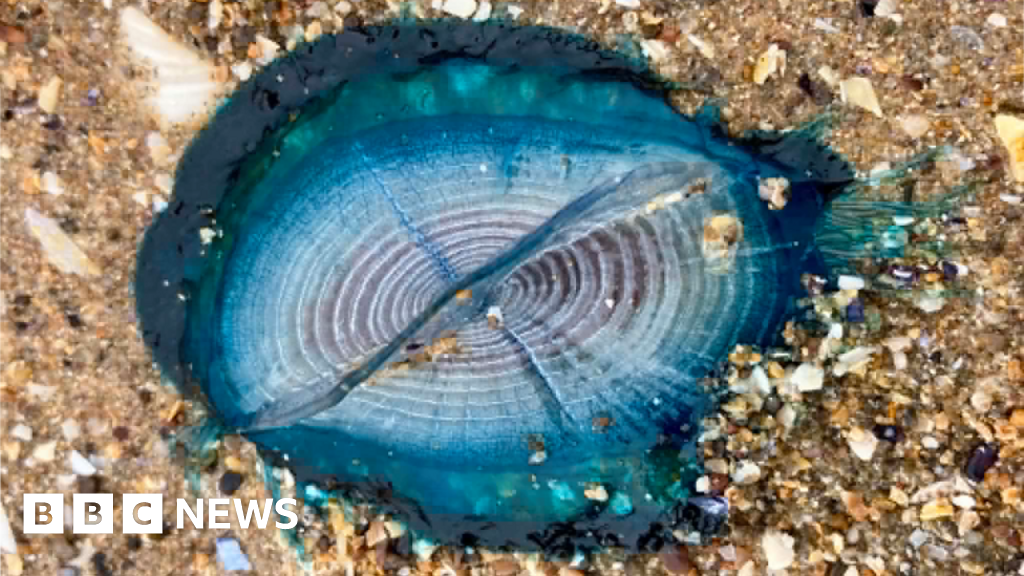
Along various stretches of the Welsh coastline, hundreds of strikingly beautiful blue sea creatures have recently made an appearance. These creatures, identified as Velella velella, are commonly known as by-the-wind sailors. They are closely related to the Portuguese man o’ war and have been found on beaches in locations including Anglesey, Gwynedd, and Tenby.
One such sighting occurred at Tenby South beach, where a woman described discovering one of these free-floating hydrozoans as encountering something “like a crystal.” Marine expert Frankie Hobro from Anglesey Sea Zoo highlighted their captivating appearance but cautioned people against handling them due to their ability to sting. Hobro explained that although by-the-wind sailors are often mistaken for their more infamous cousin, the Portuguese man o’ war, they are smaller, a brighter shade of blue, and generally harmless.
The name “by-the-wind sailors” comes from their characteristic small sail-like structure, which catches the wind and allows them to drift across the ocean surface. Hobro described the spectacle of large groups moving together as creating blue tides that glisten in sunlight, calling them “stunningly beautiful.” She also noted that these creatures typically appear during autumn and winter, carried long distances by ocean currents, and often end up stranded on shorelines after storms or shifts in currents. Measuring around 7cm, by-the-wind sailors can’t move on their own and frequently wash up in clusters because they travel with the same currents.
Similar to the Portuguese man o’ war, by-the-wind sailors are colonial animals related to sea anemones and corals, equipped with stinging cells. Though their sting is generally mild and may not be felt through regular skin, Hobro warned that contact with sensitive areas such as lips or the face could be painful and cause a tingling sensation. She stressed that even when these creatures appear dead on the shore, their stinging cells remain active, making it important to admire them from a safe distance without touching
Read the full article from The BBC here: Read More
Auto Amazon Links: No products found.