Auto Amazon Links: No products found.
Several of the United Kingdom’s leading scientific laboratories are set to experience significant scaling back of their projects after a government review of research funding. The affected research spans a broad range of fields, from developing new cancer therapies and enhancing battery technology to exploring the fundamental composition of the Universe.
Among the affected areas are particle physics experiments at CERN and various astronomy initiatives, although severe reductions initially feared have been avoided. According to the UK Research and Innovation Agency (UKRI), budget constraints require them to implement savings exceeding £160 million over the next four years due to unanticipated increases in the costs associated with planned research activities. Despite an overall rise in government spending on research and development to a record £22.6 billion annually by 2029-30, and an increase in UKRI’s share from about £9 billion to nearly £10 billion within the same timeframe, the agency acknowledges it must prioritize its investments carefully. UKRI’s Chief Executive, Professor Sir Ian Chapman, emphasized that the cuts are necessary as forecasted expenditures now outpace available funds. He stated, “Our plan is to focus the UKRI investment where it makes the largest impact.”
Investment priorities will now be strategically directed towards areas expected to yield the most significant scientific and economic benefits. That includes £1.6 billion committed to artificial intelligence, about £1 billion devoted to quantum technologies, and £750 million allocated for developing a national supercomputer. Chapman further highlighted a strategic shift, noting, “Overall, we will drive to be more entrepreneurial, to engage more with industry, to realize greater revenue and greater income into our program, which means there’s less pressure on the public purse.”
National laboratories, which are government-owned facilities housing large-scale scientific equipment and expert teams, are facing the most intense budget reductions. Funding dedicated to scientific work at these sites is projected to decline by over 50%, even though the overall budget for the labs and their facilities will decrease by a smaller margin, partly because an increasing portion must cover critical maintenance of aging infrastructure. Sue Ferns, representing technical and scientific staff at the affected labs through the Prospect Trade Union, described these changes as a “hammer blow to UK science.” She emphasized, “It is the product of a political choice. Public sector research facilities like those at Harwell, the Royal Observatory Edinburgh, and Daresbury, now facing devastating cuts, act as catalysts to regional business ecosystems, and offer training and job opportunities to their local communities.”
At Daresbury Laboratory in Cheshire, for example, the Accelerator Science and Technology Centre, responsible for creating and maintaining equipment that accelerates particle beams, will see its budget reduced by £8 million annually by 2029. Similarly, the Scientific Computing Department, split between Daresbury and the Rutherford Appleton Laboratory at Harwell in Oxfordshire, which processes roughly 25% of data from the Large Hadron Collider at CERN, will experience a £10 million yearly budget cut, alongside decreased access to computational resources. The Boulby Underground Laboratory near Saltburn on the North Yorkshire coast, which searches for dark matter—thought to be the invisible substance making up much of the Universe—will face a 40% reduction in funding.
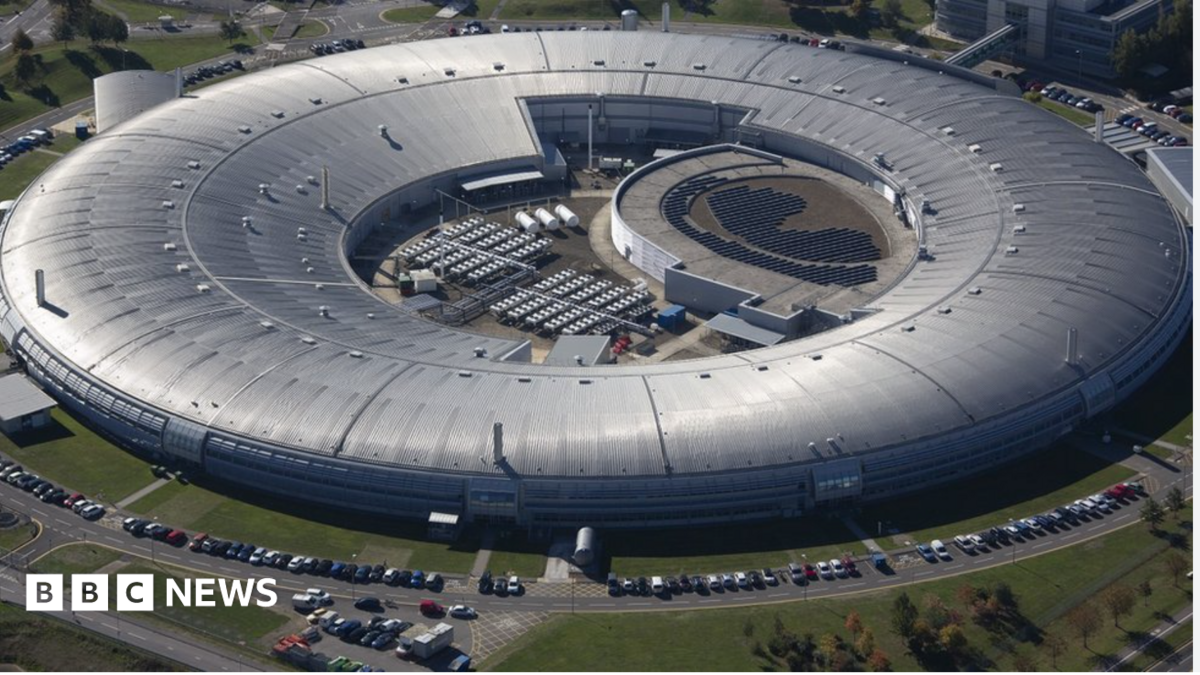
Despite these financial pressures, the UK remains committed to key international scientific collaborations. It will maintain its standing as the second-largest contributor to CERN, with an increase in its subscription fees by 19% over four years, and continue participating in global dark matter research projects. However, funding cuts will also impact multidisciplinary research facilities used nationwide to explore fundamental scientific questions. Collectively, these centers face budget reductions of approximately 15%, though a temporary £100 million transitional fund is being provided to help them seek alternative commercial sources of income. Notably, three such facilities located in Oxfordshire are affected: Diamond Light Source, a massive X-ray producing machine potentially facing a 20% reduction in beam time and uncertain upgrade prospects; ISIS Neutron and Muon Source, which will operate fewer hours with some instruments and muon experiments being shut down; and the Central Laser Facility, home to some of the world’s most powerful lasers utilized in medical imaging, cancer research, and physics, with part of its biological and chemical research division set to close.
Criticism of the planned cutbacks has come from figures within the scientific advocacy community. Daniel Rathbone, Deputy Executive Director of the Campaign for Science and Engineering, warned of the long-term negative consequences saying, “In the long term these cuts are likely to have a much bigger economic and research impact than the level of savings realised in the short term. If we lose capability in any given area, it’s likely it will be very difficult to regain in a meaningful way.” Earlier proposals suggested savings of up to 30% targeting particle physics and astronomy research, but following extensive lobbying efforts by scientists, reductions in these sectors have now been limited to just 2.7%. Nonetheless, specialist outlets like Research Professional News highlight that significant cutbacks remain inevitable due to rising costs associated with particle physics and astronomical research endeavors
Read the full article from The BBC here: Read More
Auto Amazon Links: No products found.